Loss of Friends
A heron offers to carry a dying pond's fish to safety one by one — and finds a use for every single one of them.
A rescuer with an appetite is only a slower kind of danger.
Narration voiced with OmniVoice (k2-fsa), CC-BY-NC.
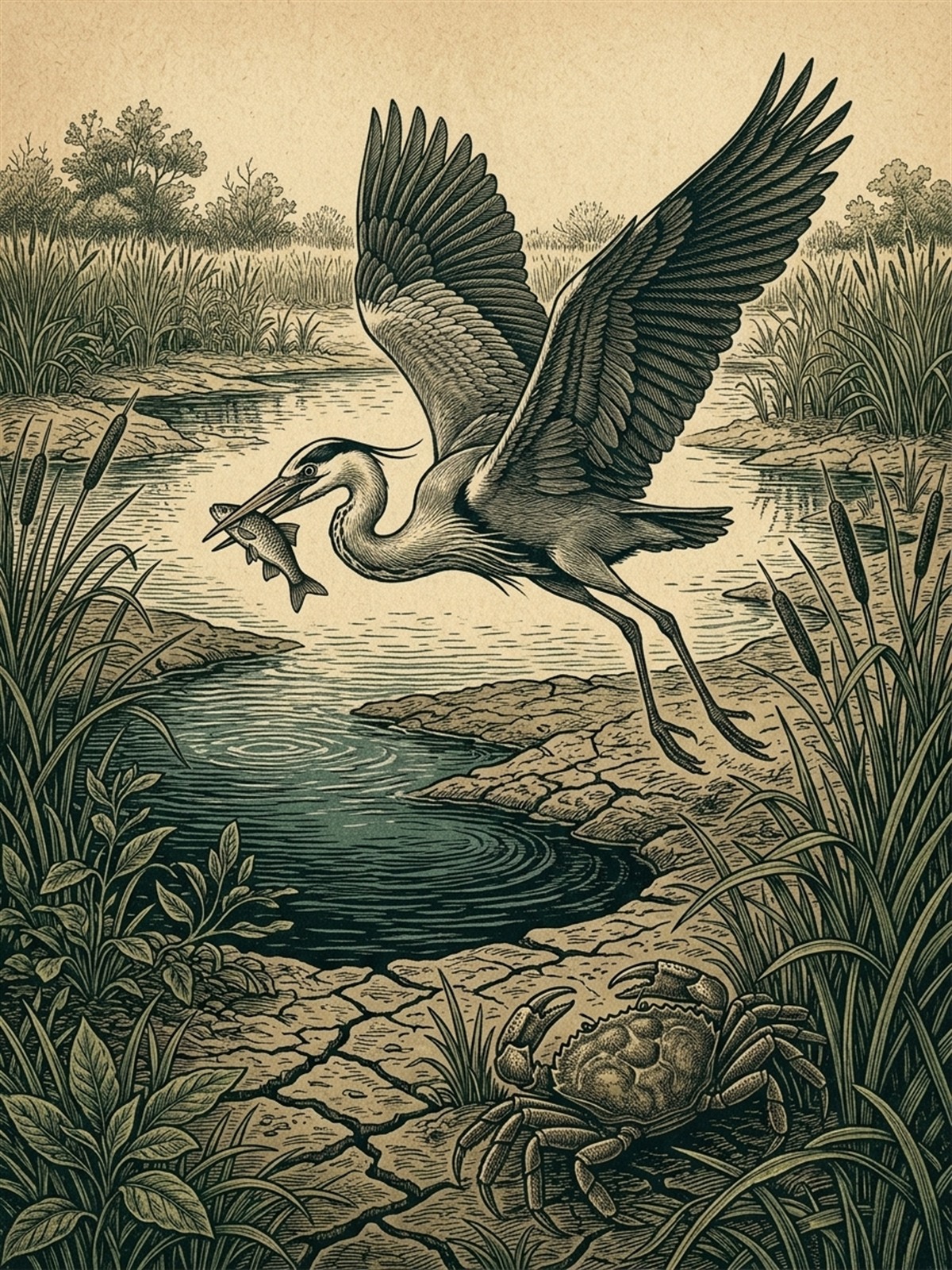
A pond had fed its fish for generations, until a dry year drank it down to a puddle with ambitions of mud. A heron came to stand at its edge, the picture of an old friend arrived just in time.
HeronI have watched this water shrink and grieved for you as my own kin. There is a lake three ridges over, full and cold. I will carry each of you there myself, one in my beak at a time, if you will trust an old neighbor.
Fish have short memories for wariness and long ones for thirst. They agreed, and drew lots for the order, grateful to a friend they had never before looked at closely.
The heron flew each one, in turn, not to a lake at all, but to a flat rock behind a stand of reeds, where he ate them at his leisure and returned for the next with an unhurried, satisfied gait.
The pond emptied of fish and filled instead with rumor. A crab, who had watched the traffic and noticed it went only one direction, asked to be carried too, when his turn should come.
CrabI am slower than a fish and twice as suspicious. Carry me gently, friend — I intend to hold on the whole way.
The heron rose with the crab gripping his neck, and set his path not toward any lake but toward the familiar rock, its floor a small white history of bones.
CrabThere is no lake here. There is only your dinner, arranged by species.
The heron opened his beak to explain himself, which is the one motion a strangled throat cannot survive. The crab's claw had already closed, patient as a debt collector, and did not loosen until the heron's neck had nothing left to argue with.
The crab walked home across the mud, in no hurry, and told the last of the fish what had become of their friend. A hand that offers to carry you is not the same as a hand that intends to set you down.
Ready to listen
1 / 10 · Studio narration